Question: I see claims of air intakes adding power, and I was wondering if there was any truth to this. I’d just like to know if they really do work, before plunking down some money for one.
Matt Jones
St. Louis, Missouri
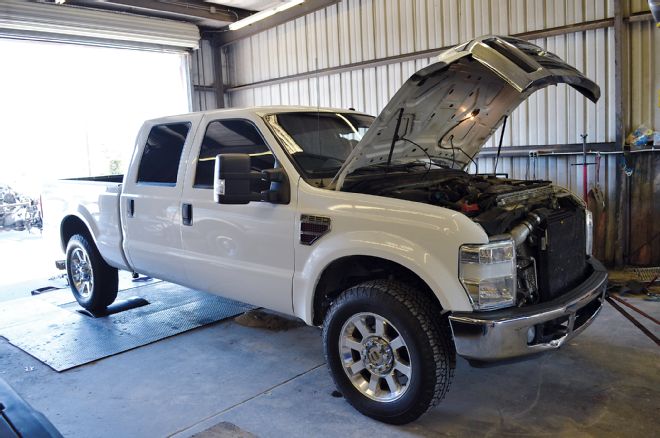 | Recently, we dyno tested a 6.4L-powered Ford truck that was on a race tune, which put out 509 hp. With an open intake, the truck picked up another 18 hp, checking in at 527 hp and roving the stock filter was indeed a restriction.
Answer: We hate to give you an ambiguous answer on this one, but the truth to the air intake horsepower story is: it depends. A lot of engineering went into diesel pickups in factory form, both old and new. The intakes are designed to support the power capabilities of the engine and aren't much of a restriction when power levels stay close to stock. However, when power increases (by adding fuel), the turbocharger ultimately spins harder and thus requires more air.
When this happens, the stock intake might not be up to the task. We say “might,” because results can vary from vehicle to vehicle. While on the dyno, we've popped the lid on more than a few airboxes (basically running no filter) to see if it made any difference in power. On a 1995 Dodge (160hp stock) at 215 hp, we tried both a drop-in filter and running no intake, and it didn’t make any difference in power. We’ve also tried this trick on a stock Duramax, with the same no-gain results.
That’s not to say, however, that intakes don’t make a difference. On more highly modified trucks, we’ve seen substantial gains from air intake systems. Especially when larger turbochargers are added, the flow should be upped on the intake as well. Even in stock form with a heavy tune, intakes can make quite a bit of difference. We saw an 18hp gain on an otherwise stock 6.4Lpowered 2008 Ford, which had a max-effort tune but stock turbos.
So, basically, if you’re looking at stepping up to a new turbocharger or adding a lot of power via a programmer, an intake is a good idea. If your truck is mostly stock, it probably won’t add much power, but it will sound cool.
| Recently, we dyno tested a 6.4L-powered Ford truck that was on a race tune, which put out 509 hp. With an open intake, the truck picked up another 18 hp, checking in at 527 hp and roving the stock filter was indeed a restriction.
Answer: We hate to give you an ambiguous answer on this one, but the truth to the air intake horsepower story is: it depends. A lot of engineering went into diesel pickups in factory form, both old and new. The intakes are designed to support the power capabilities of the engine and aren't much of a restriction when power levels stay close to stock. However, when power increases (by adding fuel), the turbocharger ultimately spins harder and thus requires more air.
When this happens, the stock intake might not be up to the task. We say “might,” because results can vary from vehicle to vehicle. While on the dyno, we've popped the lid on more than a few airboxes (basically running no filter) to see if it made any difference in power. On a 1995 Dodge (160hp stock) at 215 hp, we tried both a drop-in filter and running no intake, and it didn’t make any difference in power. We’ve also tried this trick on a stock Duramax, with the same no-gain results.
That’s not to say, however, that intakes don’t make a difference. On more highly modified trucks, we’ve seen substantial gains from air intake systems. Especially when larger turbochargers are added, the flow should be upped on the intake as well. Even in stock form with a heavy tune, intakes can make quite a bit of difference. We saw an 18hp gain on an otherwise stock 6.4Lpowered 2008 Ford, which had a max-effort tune but stock turbos.
So, basically, if you’re looking at stepping up to a new turbocharger or adding a lot of power via a programmer, an intake is a good idea. If your truck is mostly stock, it probably won’t add much power, but it will sound cool.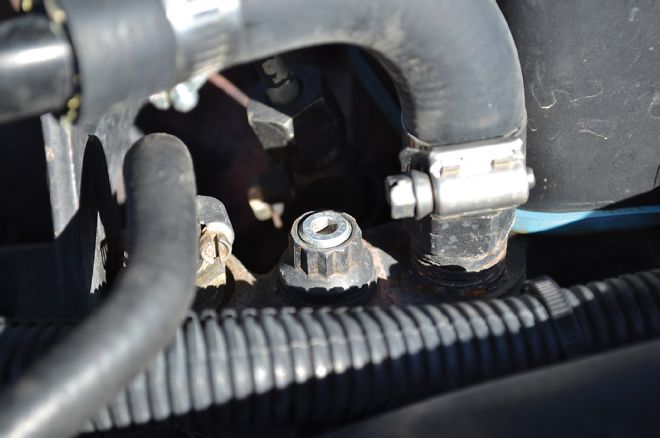 | Using head studs (rather than bolts) is a good way of increasing clamping force and leads to a much stronger head gasket seal, which is important as boost pressures rise to double or even triple that of stock.
Total Studs
| Using head studs (rather than bolts) is a good way of increasing clamping force and leads to a much stronger head gasket seal, which is important as boost pressures rise to double or even triple that of stock.
Total Studs
Question: I’m going to be upgrading my 1997 Dodge Ram for more power, and I’m a bit confused when it comes to head gaskets. I was looking at ARP studs for the engine and was wondering whether I should buy the more expensive 625+ studs, or if the normal ones are fine. Help!
Jonathan Marks
Tempe, Arizona
Question: I have an 2008 GMC with the Duramax diesel engine, and I have a problem. It doesn’t always start, and sometimes I have to prime it to get it to fire. I’ve checked for fuel leaks and can’t find any. There are no “check engine” codes, either. Any ideas on what my starting problem could be?
Nathan Laughlin
via email
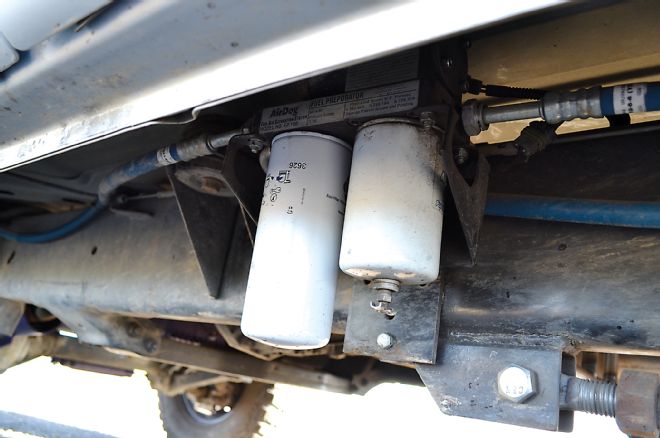 | While new Duramax engines are proving to be very reliable, they too have their Achilles’ heels. Although it’s hard to tell by looking, a cracked fuel filter housing or leaking O-rings are common problems resulting in a no-start situation.
Answer: We’re starting to see this problem more and more with later-model Duramax engines, where the truck initially runs fine, but after being shut down for a moment, it will not restart.
Pumping up the fuel primer (located by the filter) usually does the trick to get the engine fired, and it typically will run fine thereafter. The problem can be caused by a crack in the fuel-filter housing, or a compromised O-ring. Either will allow air to leak into the fuel system, which prevents the engine from starting.
Fortunately, new filter housings aren’t that expensive (less than $200) or hard to replace. Another option involves stepping up to a stand-alone fuel system such as a Fuelab, FASS, or AirDog, which have their own filtration systems. Either way, it will be problem solved as far as the no-start situation goes.
| While new Duramax engines are proving to be very reliable, they too have their Achilles’ heels. Although it’s hard to tell by looking, a cracked fuel filter housing or leaking O-rings are common problems resulting in a no-start situation.
Answer: We’re starting to see this problem more and more with later-model Duramax engines, where the truck initially runs fine, but after being shut down for a moment, it will not restart.
Pumping up the fuel primer (located by the filter) usually does the trick to get the engine fired, and it typically will run fine thereafter. The problem can be caused by a crack in the fuel-filter housing, or a compromised O-ring. Either will allow air to leak into the fuel system, which prevents the engine from starting.
Fortunately, new filter housings aren’t that expensive (less than $200) or hard to replace. Another option involves stepping up to a stand-alone fuel system such as a Fuelab, FASS, or AirDog, which have their own filtration systems. Either way, it will be problem solved as far as the no-start situation goes.