Some time ago, we asked several Mopar engine builders to share their secrets—their favorite combinations. The amount of mail that we received encouraged us to again query engine builders and manufacturers for their favorite Mopar builds.
The result is the accompanying eight combinations. Big-blocks, small-blocks, Hemis—if it is a proven combination from a known source, you’ll find it here.
From mild street to radical race, we have you covered. So without further adieu, we offer eight Mopar combinations that will get you thinking about your next Mopar engine.
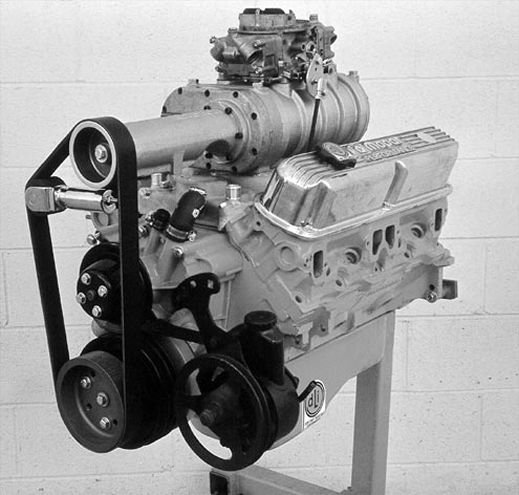
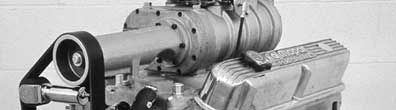
dLi '71-'91 360 Supercharged
Application Notes and Builder's Recommendations: Build big-block power from your much lighter small block with dLi. Excellent throttle response and great reliability. Basically a stock 360 engine with cleaned up heads and a performance cam. Top it off with the blower and a bigger carb. No rocket science needed here, just a little hood clearance. Most passenger cars could use a Six Pac-type scoop, or if you have a truck, you won't even need that! What you get is a small-block that makes over 320 lb/ft at 2,500 rpm and holds it above 330 lb/ft all the way to 7,000 rpm!
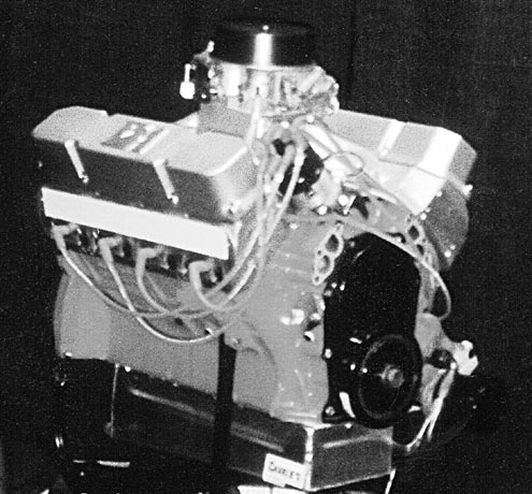
B-1 B/S Bracket Bomber
Application Notes and Builder's Recommendations: This engine is an excellent all-around bracket engine for door cars and dragsters alike. It requires low maintenance with a broad torque and power band, making it good for a number of Super classes. The engine is based off of a '71-'75 400 block and uses a Koffel's Place aluminum pan with Milodon oiling system.
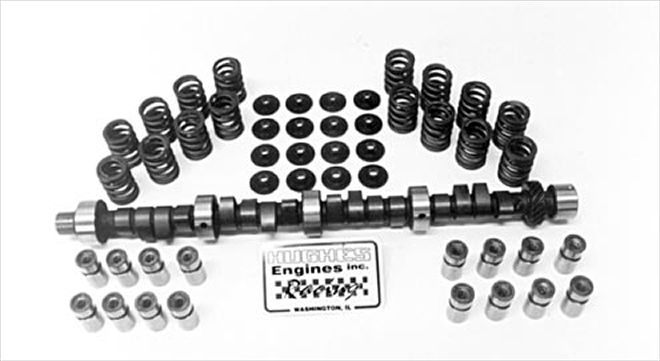
Hughes Engines' Bracket Racer or Oval Track Modified
Application Notes and Builder's Recommendations: This basic combination can be a winner in oval track modified classes against larger, roller cammed Chevys. Additionally, for drag racing set-ups, it should take a 3,200-pound car into the mid-10s with proper gear ratio, torque converter stall speed, and chassis setup.
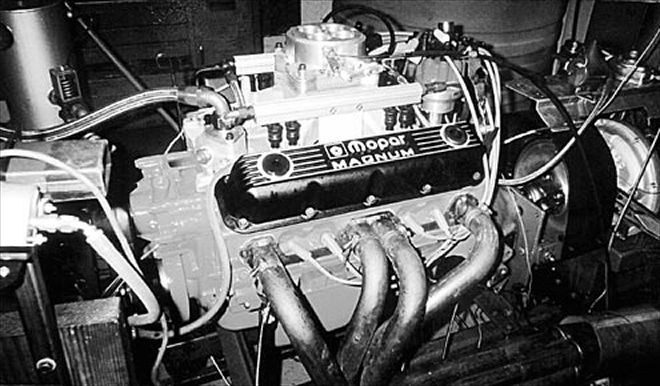
RAM Racing Engines/Rance Fuel Injection MP 360/380 Crate
Application Notes and Builder's Recommendations:
Perhaps one of the most popular crate engines on the market today is Mopar Performance's 360/380 Magnum Crate Engine. With its gaining popularity in bracket racing categories and installation in street/strip Mopars, the 360/380 has lived up to its expectations of being the best performance small-block buy.
RAM Racing Engines and Rance Fuel Injection have combined forces to make the 360/380 even more powerful, while at the same time adding a level of street performance that makes for great cruising and all-out race performance.
For comparison's sake, consider that the stock MP 360/380 at RAM Racing Engines made 377hp at 5,500 and 413 lb/ft of torque at 4,500 as shipped. With a cam change, and nothing else, that power figure raised to 423hp at 6,000 and 421 lb/ft of torque at 4,800. Finally, with the cam and the installation of a Rance-engineered electronic fuel injection system, peak power improved to 448hp at 5,000 and 438 lb/ft of torque at 4,900 rpm. The fuel injected combination produced the same horsepower at 4,900 rpm that the stock 360/380 made at 5,500 rpm. By widening the power band, the result is better driveability of the fuel injected crate engine which is a result of controlling spark and fuel and inducting fuel at the intake valve. Even more importantly, this combination made over 400 lb/ft of torque from 4,100 to 5,800 rpm.
Edelbrock Performer RPM 340
Application Notes and Builder's Recommendations: Off the shelf parts make this 340 a real street performer that only Edelbrock could conceive. With over 300 lb/ft of torque everywhere on the torque curve, the Edelbrock Performer RPM 340 shows that the intermediate LA engine can put out power.
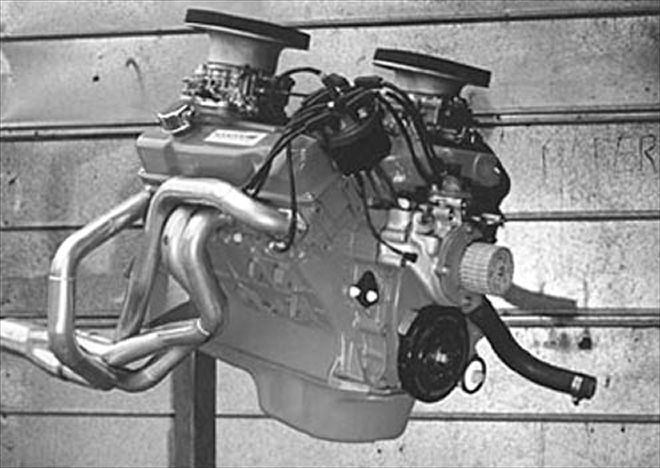
Dvorak Machine's Maximum Wedge
Application Notes and Builder's Recommendations: Dan Dvorak doesn't mince words to describe this Max Wedge-style combination: "My purpose was to make a reasonably priced, factory looking, period correct engine. This is a bulletproof combination that can boogie. We have done just that, with only the intake manifold giving hint to true potential. This is the essence of Super Stock!"
Dan continues, "Peak horsepower would produce 9.50 to 9.80 quarter mile e.t.s in a '62-'64 3,200-pound B-Body depending on how good the car is set up. We don't play the horsepower game. Weight, existing parts, chassis ability, and budget is the real game!
"Yes, we could have used a mega-block with a 4.500-inch bore; yes, we could have gone to an aluminum head and an additional 100cfm, and there is plenty of additional HP left in the valvetrain, but..."
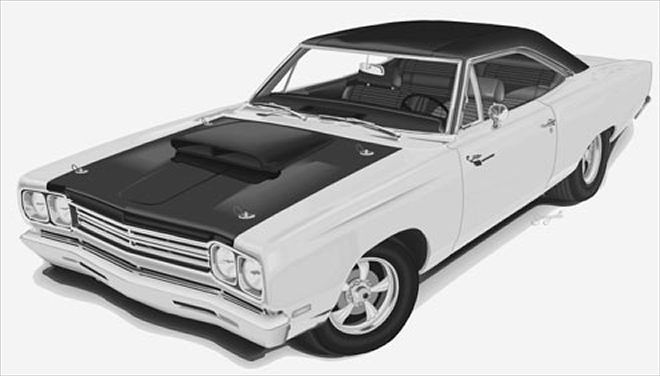
Indy Cylinder Head 542ci Wedge
Application Notes and Builder's Recommendations: The cornerstone of the performance behind the Holley Project Roadrunner will be this stout combination engineered by Ken Lazzeri. Ken notes, "This is a 9:1 engine with a dual-plane intake, vacuum secondary carb, and designed to run really smooth. Sure, it will produce somewhere between 550 and 600hp, yet the only exotic part is the oiling system necessitated by the extra stroke.
Shepard Speaks Out
When the topic of street performance and Mopar Performance comes up, you know that Larry Shepard will have an opinion. We queried Larry on his upgrades and combinations and this is what he had to share. But first, he had some parameters.
"What you would like to see for good street performers is one horsepower per cubic inch, 9:1 compression so that it runs on pump premium (10.25:1 for aluminum heads), and a hydraulic cam for low maintenance and quiet operation. Of course, our crate engines are great options, but for those who want a little more....
Brute Force Big Block
Here's a performance upgrade for big-block Wedge MP crate engines or general HP 440. You should have thrown away the old production-based castings--like the 906--maybe 10 years ago and moved up to the 2.14/1.81 Stage Vs. Not everyone did because there are so many 906s. Now MP has the new, cast-iron Max Wedge (P5249824) with 2.14/1.81 valves. There is an actual Stage III replacement (P4529997) with 2.08/1.88 valves, but there is no reason to use it if you can get the 2.14-inch intake valve version. It flows more air. Getting good flow data for any of these old heads is very difficult, but an average, un-prepped, stock head with some number of valve jobs--remember, these heads are over 30 years old--probably flows less than 200cfm.
On this same flow bench, a similar Max Wedge head might flow 240, 250, 260--or more! Even if it is the most conservative number, it is still 40cfm better than the old production head. That big gain works with anything! You would probably get a similar power gain--upwards of 20 percent and 1 horsepower per cubic inch.
Not everyone wants cast-iron heads; some want aluminum. So there is a similar upgrade available with the aluminum Max Wedge Stage VI head (P5249579). It has the big Max Wedge window port raised for added flow and power benefits. You want a 10.25 to 10.5:1 compression ratio max and this head delivers with its smaller combustion chamber. You need eight offset rockers to go with the big, straighter intake ports (P4876438-439 for 1.5:1 ratio, P4876440-441 for 1.6:1 ratio) and four lefts and four rights are required.
With raised ports, to get the manifold to line-up properly, you need a wider intake manifold. You can use adapter plates (P5249189) with any RB intake or you could use the Stage VI race intake (P5249358) which is full width and has large ports, but not quite as large as the Max Wedge. Finally, you could also use the new Max Wedge Stage VI version (P4876128).
More Power, Fewer Parts
Not everyone wants big-port heads like the Max Wedge. One of the problems is that there are very few intakes that feature the big Max Wedge intake port. Since this limits many people, they prefer the standard size ports so they can use a manifold they already have. Just because these racers may not want big ports doesn't mean they don't want to flow more air, make more power, or have aluminum heads. To make all of these things happen--added flow, more power, and aluminum heads--with no added parts, upgrade to the aluminum 440 head (P4876311).
Techno-Hemi
Any of the 426 Hemi engines, including the 528 Crate, can be improved with the addition of the CNC-ported aluminum Hemi head (P4876355). Everything fits, except if the engine has cast-iron heads and 9:1 compression currently. To use the CNC Hemi head, you'll want to move to 10:1 c.r.
Small Block Heads
On the vast number of 360 small blocks, the first upgrade would be to swap the old 915, X or J castings and move up to the 576 family. For a 360-style head with 1.88/1.60 valves choose P4529269. For a 340 with 2.02/1.60 valves, choose the P5249574 head. Follow by adding an M1 intake--either single or dual plane depending upon application. The next small block upgrade would be the W2 heads and dual plane, oval-port intake (P5249572).
Econo Small Block
At the econo or claimer racer level, you have a less-expensive approach--especially if you do most of your own work and begin with the MP Short Blocks. Move from there and add a Magnum head or head assembly and an M1 intake (P5249500-501) and you are well on your way. The nice part is that you have so many selections--four short blocks, dozens of heads and head assemblies, and an unknown amount of intake manifolds.